Pour accéder à la série en entier, vous devez vous logger ou demander un compte Hans Lucas en cliquant ici.
Chrétiens de Turquie
Dans le temps, ma mère devait payer pour avoir un siège individuel tant l’église était bondée. Il y avait alors six chan- teurs. Aujourd’hui, il n’y en a plus qu’un », regrette Yorgo Istefanopoulos, un vieux fidèle de l’église grecque-orthodoxe Sainte- Euphémie, à Kadikoy, le centre culturel de la rive asiatique d’Istanbul. Six personnes seulement assistent à la divine liturgie ce matin. Il faut dire que la présence chrétienne en Turquie est passée de 20%au débutXXe siècle à 0,2%de la population, d’après l ’étude World Christian Database de 2023. Et cela même dans l’ancienne Constantinople, jadis capitale de l ’Empire romain d’Orient où demeure le patriarcat œcuménique orthodoxe. C’est pourtant là que le pape François devait retrouver le patriarche Bartholomée pour célébrer les 1 700 ans du concile de Nicée. Signe des temps, il y a cinq ans, la baisse du niveau des eaux du lac d’Iznik (nouveau de nom de Nicée) a révélé les ruines immergées de la basilique qui fut construite peu après cet événement décisif pour l’histoire de l’Église.
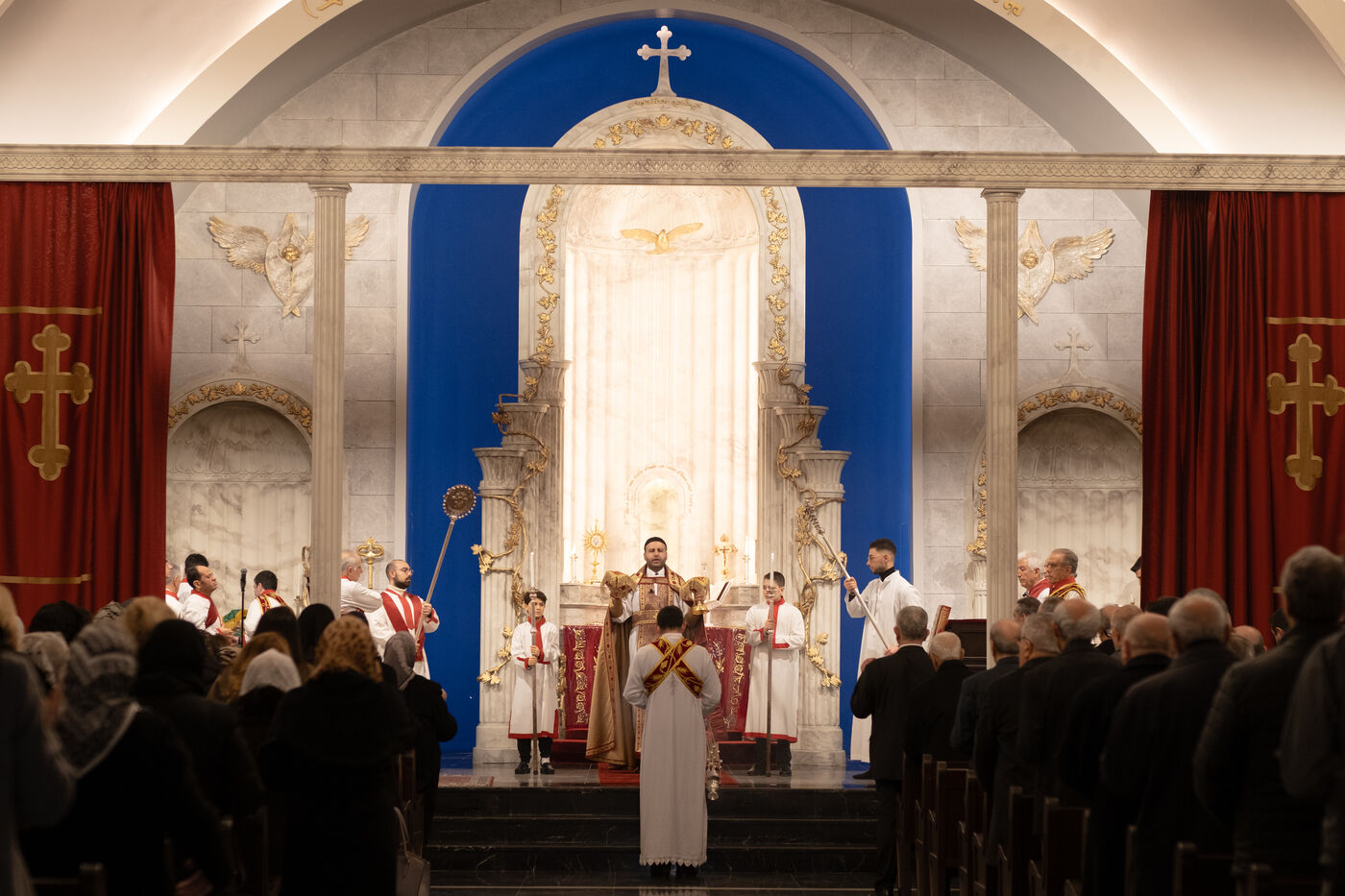
L’affluence à l ’église syriaque orthodoxe Saint-Éphrem tranche avec cette atmosphère de déclin. C’est un édifice flambant neuf, inauguré en 2023 en présence du président Erdoğan. Il est quasiment plein en ce dimanche matin. Il y a peu, les fidèles devaient encore louer un endroit pour se rassembler. L’église se situe à Yeşilköy, un quartier d’Istanbul où vivent une bonne par- tie des près de 20 000 syriaques de la ville, des chrétiens qui ont conservé la langue araméenne. Après l ’office, un déjeuner a lieu dans une grande pièce, au sous-sol. Saint-Éphrem a été la première église érigée depuis la création de la Turquie moderne en 1923, sur un terrain légué par le pouvoir, puis financé par des fidèles.
Dans le sous-sol de l’église syriaque, les petits enfants courent sous le portrait du patriarche décédé. Ce lieu, qui a des airs de maison de famille, est bien protégé par un portique de sécurité. Car la vigilance a été renforcée dans toutes les églises de la capitale après que deux assaillants masqués ont ouvert le feu le 28 janvier 2024, à Santa Maria de Sarıyer, fondée en 1693 par des Italiens, au bord du Bosphore. « C’était le pire jour de ma vie, et en même temps, celui où j’ai vu le plus grand miracle. » Ce matin-là, le franciscain Anton Bulai, prêtre de l’église attaquée, célébrait l’office lorsque des terroristes ont ouvert le feu. « Leurs deux fusils se sont bloqués ! Plus de 10 personnes seraient mortes sans cela », appuie-t-il, derrière ses lunettes aux verres fumés. Un laser en main, il désigne les impacts de balles, sur un banc et dans un mur, qui ont fait un mort avant que les armes ne s’enrayent. Le prêtre pousse ensuite une porte, qui mène sous la crypte. Au bout du tunnel, un tombeau contient une urne avec le sang du défunt, qui a été pieusement recueilli après l’attaque.
« Certains fidèles ont peur, d’autres se battent pour guérir intérieurement, mais grâce à leur foi, ils reviennent à l’église », observe le souriant sexagénaire. Désormais, la police est constamment postée devant l’édifice. Le 1 700e anniversaire du concile de Nicée est une occasion pour les fidèles de se rappeler la longue histoire qui les rattache à ce pays et d’affermir la foi en Jésus-Christ vrai homme et vrai Dieu, Lui pour lequel ont vécu tant de fidèles et de moines à Constantinople, en Cappadoce comme sur les côtes de l’Asie mineure.
Christians in Turkey
In the past, my mother had to pay for an individual seat because the church was so crowded. There used to be six singers. Today, there is only one," laments Yorgo Istefanopoulos, a long-time member of the Greek Orthodox Church of Saint Euphemia in Kadikoy, the cultural center of Istanbul's Asian shore. Only six people are attending the divine liturgy this morning. It must be said that the Christian presence in Turkey has fallen from 20% at the beginning of the 20th century to 0.2% of the population, according to the 2023 World Christian Database study. This is even true in ancient Constantinople, once the capital of the Eastern Roman Empire and home to the Ecumenical Patriarchate of Constantinople. Yet it was there that Pope Francis was to meet Patriarch Bartholomew to celebrate the 1,700th anniversary of the Council of Nicaea. In a sign of the times, five years ago, the falling water level of Lake Iznik (the new name for Nicaea) revealed the submerged ruins of the basilica that was built shortly after this decisive event in the history of the Church.
The crowds at the Syriac Orthodox Church of St. Ephrem contrast with this atmosphere of decline. It is a brand-new building, inaugurated in 2023 in the presence of President Erdogan. It is almost full on this Sunday morning. Until recently, the faithful still had to rent a place to gather. The church is located in Yeşilköy, a neighborhood of Istanbul where a large part of the city's nearly 20,000 Syriacs live, Christians who have preserved the Aramaic language. After the service, lunch is held in a large room in the basement. Saint Ephrem was the first church built since the creation of modern Turkey in 1923, on land bequeathed by the government and financed by the faithful.
In the basement of the Syriac church, small children run under the portrait of the deceased patriarch. This place, which has the feel of a family home, is well protected by a security gate. Security has been tightened in all the churches in the capital after two masked assailants opened fire on January 28, 2024, at Santa Maria de Sarıyer, founded in 1693 by Italians on the banks of the Bosphorus. "It was the worst day of my life, and at the same time, the day I saw the greatest miracle. “ That morning, Franciscan Anton Bulai, priest of the attacked church, was celebrating Mass when terrorists opened fire. ”Their two guns jammed! More than 10 people would have died if that hadn't happened," he says, behind his dark glasses. With a laser pointer in his hand, he points to the bullet holes in a bench and a wall, which killed one person before the weapons jammed. The priest then pushes open a door that leads to the crypt. At the end of the tunnel, a tomb contains an urn with the blood of the deceased, which was piously collected after the attack.
“Some of the faithful are afraid, others are struggling to heal internally, but thanks to their faith, they are returning to church,” observes the smiling 60-year-old. From now on, the police are constantly stationed in front of the building. The 1,700th anniversary of the Council of Nicaea is an opportunity for the faithful to remember the long history that binds them to this country and to strengthen their faith in Jesus Christ, true man and true God, for whom so many faithful and monks lived in Constantinople, Cappadocia, and on the coasts of Asia Minor.