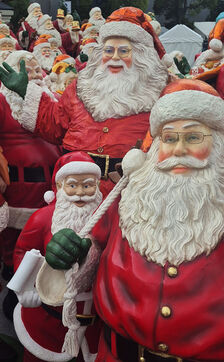
Père Noël business
Avec l'arrivée des premiers immigrés aux États-Unis, « Sinter Klaas » devient Santa Claus. En 1821, un pasteur américain, Clement Clarke Moore, publie un conte de Noël pour enfants intitulé « The Night before Christmas », dans lequel Saint-Nicolas est présenté comme un lutin sympathique, dodu et souriant, qui distribue des cadeaux dans les maisons et se déplace sur un traîneau. Le récit est traduit dans le monde entier. C’est le point de départ du mythe actuel du Père Noël qui arrive la veille de Noël plutôt que le jour même.
En 1863, le dessinateur Thomas Nast publie une illustration dans Harper’s Illustrated Weekly, dans lequel Santa Claus porte un costume bordé de fourrure blanche et un large ceinturon de cuir. Pendant 30 ans, Nast illustra de ses dessins tous les aspects de la légende de Santa Claus : un petit bonhomme rond, vêtu d’une houppelande en fourrure, la pipe au coin de la bouche. C’est aussi Nast qui situe sa résidence au Pôle Nord.
En 1931, l’illustrateur Haddon Sundblom dessine le Père Noël en personnage en rouge et blanc, aux couleurs de Coca-Cola.
Santa Claus, a worldwide celebration
With the arrival of the first immigrants in the United States, "Sinter Klaas" evolved into "Santa Claus." In 1821, an American minister named Clement Clarke Moore published a Christmas tale for children titled "The Night Before Christmas," in which Saint Nicholas is portrayed as a friendly, plump, and smiling elf who travels by sleigh to deliver gifts to homes. Rudolph, the little reindeer with the red nose who lights the way, did not appear until 1839. The story was translated all over the world, marking the origin of the modern-day Santa Claus myth—a figure who arrives on Christmas Eve rather than on Christmas Day itself. In 1863, the illustrator Thomas Nast published a drawing in Harper’s Illustrated Weekly depicting Santa Claus in a suit trimmed with white fur and a wide leather belt. Over the next 30 years, Nast used his illustrations to flesh out every aspect of the Santa Claus legend: a round, jolly little man dressed in a fur-lined coat, with a pipe tucked into the corner of his mouth. It is also Nast who places his residence at the North Pole. In 1931, illustrator Haddon Sundblom depicted Santa Claus as a figure in red and white—the colors of Coca-Cola.